

Crow pose yoga is one of the most powerful and exciting yoga poses that challenges both your strength and balance. Many beginners feel nervous when trying it for the first time, especially because it involves lifting the entire body using the arms.
Crow pose yoga is not just about arm strength, it is about control, focus, and proper body alignment. When done correctly, it helps you build deep core strength and body awareness.
This pose teaches you how to trust your body and overcome fear. With the right approach, anyone can learn to balance and fly safely.
What is Crow Pose Yoga and Why It Matters?
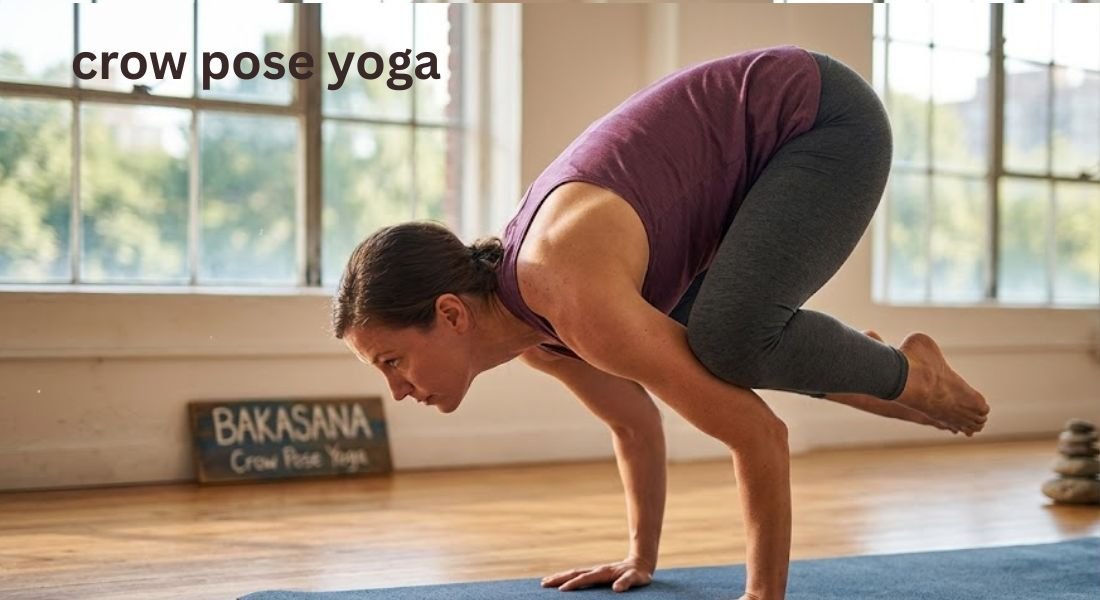
Crow pose also known as Bakasana is an arm balance posture where your body weight shifts onto your hands while your knees rest on your upper arms. At first, it may look like a simple balance but in reality, it is a full-body coordination exercise.
This posture demands that your nervous system and your muscular system work in perfect harmony to maintain a stable center of gravity over your wrists.
This yoga pose exercise is important because it activates multiple muscle groups at the same time. Your core stabilizes the body, your arms support the weight and your mind controls balance. Unlike basic yoga poses, this movement builds both physical strength and mental focus.
Step by Step: Crow Pose Yoga Lift Off
If you want to skip the struggle and fly with confidence you should follow this advanced technical progression. Most tutorials tell you to just “lean forward” but we are going to focus on the micro adjustments that actually create the float.
Phase 1: The Foundation
Start in a deep squat with your feet together and your knees wide apart. Plant your hands firmly on the floor about shoulder width apart and spread your fingers as wide as possible to create a massive base. This is the most important part because your hands are now your feet and they need a solid connection to the ground.
Phase 2: The High Shelf
Instead of placing your knees on the outside of your arms try to get them as high into your armpits as possible. This creates a more vertical stack of weight which makes the balance feel significantly lighter. Press your knees firmly against the back of your triceps to create friction and stability.
Phase 3: The Gaze Shift
This is where most people fail because they look down at their hands which causes the head to drop and the body to follow. Keep your eyes focused about a foot in front of your fingertips on a single unmoving point. Looking forward shifts your center of mass just enough to naturally lift your toes off the mat.
Phase 4: The Squeeze
As you lean forward and feel your weight shift into your fingertips do not just lift your feet. Instead think about squeezing your heels toward your glutes and touching your big toes together. This engagement of the hamstrings creates a “compact” shape that is much easier to balance than a loose or heavy lower body.
The Power Behind Crow Pose Yoga:
To outshine the competition and understand this pose at an expert level you must look at the specific anatomy involved.
Many beginners mistakenly believe that having big biceps is the key to balancing but the truth is much more interesting. The power behind crow pose yoga actually comes from your back and your deep abdominal wall.
- The Protracted Shoulders: Your shoulder blades must wrap around your rib cage to create a stable shelf for your knees.
- The Wrist Flexors: Your fingers act like brakes on a bicycle by pressing into the mat to prevent you from tipping too far forward.
- The Hip Flexors: You need strong hip flexors to pull your knees high into your armpits which keeps your weight centered.
- The Spinal Extensors: Your back muscles work to keep your spine from collapsing into a rounded ball so you can maintain a long and strong line.
Advanced Crow Pose Variations for Strength & Balance:
Once you can hold the basic pose for thirty seconds it is time to challenge your body with more complex versions. These variations will help you build the extreme core strength needed for handstands and other elite arm balances.
The Crane Pose (Kakasana)
In this version you straighten your arms completely which requires much more shoulder stability and core control. It is the “straight arm” version of the crow and is considered the gold standard for advanced practitioners.
Side Crow (Parsva Bakasana)
This involves twisting your torso so that both knees rest on the outside of one arm. It is an incredible way to build oblique strength and improve the mobility of your spine while balancing.
One Legged Crow (Eka Pada Bakasana)
For the ultimate test of focus try extending one leg straight back into the air while keeping the other knee tucked into your armpit. This requires massive glute strength and a perfectly centered gaze to prevent tipping over.
Benefits of Crow Pose Yoga:
Practicing crow pose yoga offers rewards that go far beyond just a strong upper body and a toned core. It is a full body medicine that improves digestion by compressing the abdominal organs and helps relieve lower back pain by strengthening the deep pelvic stabilizers.
Mentally it develops an intense level of focus and “Dharana” or concentration that helps you stay present in a fast paced world. When you learn how to balance on your hands you are essentially learning how to find your center in the middle of a challenge.
This resilience translates to every other area of your life making you a more balanced and capable individual overall.
Common Mistakes to Avoid:
- One of the biggest mistakes is relying only on arm strength instead of engaging the core. Without core support, the pose becomes unstable and difficult.
- Another mistake is looking down. This shifts your weight backward and prevents you from lifting your feet. Always keep your gaze slightly forward.
- Placing knees too low on the arms is another issue. This increases weight pressure and makes balancing harder. Try to place knees higher for better support.
- Lastly, rushing the movement can cause imbalance. Slow and controlled motion is the key to mastering this pose.
Tips to Improve Faster in Crow Pose:
- If you are struggling, start by practicing balance with one foot lifted at a time. This reduces fear and builds confidence.
- You can also place a cushion in front of you to remove the fear of falling. This helps you focus more on technique rather than fear.
- Strengthening your core through planks and simple exercises will also improve your progress in crow pose.
- Practicing regularly, even for a few minutes daily, will bring noticeable improvement.
Conclusion:
Mastering crow pose yoga is a significant milestone that proves your body is capable of much more than you ever imagined. By focusing on the subtle shift of weight and keeping your gaze steady you can turn a challenging arm balance into a moment of complete stillness.
Remember that flight is not about forcing your way up but rather finding the perfect alignment where your core and breath work together.
Whether you lift off for one second or one minute the real victory is the focus and mental strength you develop every time you step onto your mat. Consistency is the only secret to success so keep showing up and eventually gravity will simply stop holding you back.
FAQs:
Why do my wrists hurt during crow pose yoga?
Pain usually occurs when you dump all your weight into the heels of your hands instead of your fingers. You must claw the mat with your fingertips to distribute the pressure and protect the delicate wrist joints.
Can I practice crow pose yoga if I am overweight?
Yes because this pose relies on physics and leverage rather than your specific body weight or size. Focus on getting your knees as high as possible into your armpits to create a more efficient center of gravity.
Can kids learn crow pose yoga safely?
Kids often find this pose easier than adults because they have a high strength-to-weight ratio and less fear of falling. It is a fantastic way for them to develop coordination and build physical confidence through playful movement.
How do I transition from crow to a headstand?
Once stable, you slowly lower the crown of your head to the floor while keeping your core tightly engaged for control. This transition is a great way to build the spatial awareness needed for more advanced inversions and transitions.
